When I was about 16 I had an English teacher who in many ways was responsible for my main interests. Sir Gawain and the Green Knight was one book he lent to me which has had a lasting impact. The other book was a very slight volume he lent to me when he knew I loved science fiction. I read almost anything I could get from the library: Lem, Ballard, Herbert, and I positively devoured Arthur C Clarke. When he said it was written between the wars and was by an author more notable for his novels exploring the class system, I was less than enthusiastic but I tried it. It was called "The Machine Stops"
The world in 1927 cannot be imagined now, it was before the Wall Street crash and all its global ramifications and technology appeared to be the solution of so many problems both of the individual and society. It must have been a time of optimism; the horrors of the Great War were receding, the League of Nations was flourishing and travel was getting easier and quicker. Many writers created utopias out of these trends but "The Machine Stops" took a dystopian view.
http://www.youtube.com/watch?v=kvrGUnIFuRs
Forster's future world was an underground hive of cells, interconnected electrically so that information, music, pictures and films could be shared. The human body had become flabby and weak from lack of exercise. The machine in the title was a sort of centralised computer which ran everyone's lives, it fed them, and gave them every bodily comfort. The surface of the world was believed to be too dangerous even to visit without safety equipment. With all the entertainment and information anyone could desire available on a screen, almost everyone in this world stayed in their cells. The book is only fifty odd pages and the very faithful 1960's film is less than an hour. Please read or watch it!
Draw your own comparisons with our world as it is now but please bear in mind that it was written nearly ninety years ago.
When I reread it a week or so ago I realised how good the book was and how I think it should be required reading for teachers, software developers and anyone who cares about being fully human. We're products of the world: we evolved intelligence as a means of survival. We made tools to change our world, and far wiser people* than me have raised the problems of over reliance on the newer tools full of silicon processors. As Forster so presciently showed, our children need to get out there and explore our wonderful world, not just sit at screens pretending to do so. We need to engage in reality to be fully healthy, and I don't mean just physical health. I grew up in a world where I was encouraged to explore and put myself at risk. As my mum said very recently: "You've always managed to do dangerous things safely". Risk is to be managed and enjoyed, not to be run away from.
*Stanley Kubrick and Arthur C Clarke for two.
Saturday, 18 January 2014

Monday, 5 March 2012
Training, Eating, Pedalling, Drinking......
I've always had issues with my weight. From being called "Tank" aged 10, through consistently wobbling my way to next-to-the-last in weekly cross-country races as a young teen, to hobbling on my damaged joints if I weigh more than 98kg. In fact about the only times I've felt slender and good about my body are in times of high emotional instability: falling in or out of love usually. Occasionally, both at the same time.
I'm being narratively selective here of course: my late teens and early twenties were spent walking, cycling, running and climbing and I had a healthy, fit lifestyle too. I discovered rock climbing and realised that basic cardiovascular fitness and strength could enhance my performance, achievements and subsequent pleasure. I also discovered the value of good nutrition and became adept at choosing food and drink that could be carried easily in a small rucksack!

In a moment of hubris I attempted a climb a bit beyond me. I fell, my protection unzipped and I landed feet first on a boulder and broke all three bones in my ankle. So aged 23 I could not run, found walking painful, and could not climb to any decent standard. So I started scuba diving, not exactly high intensity work. Looking back, I don't think I did any significant cardiovascular exercise for about twenty years when I rediscovered cycling, but only as a commuter in London. I flirted with the YMCA gym but it was a one sided affair and we split up after a year.
Last year I took the decision to train for and complete a cycling century. I used a fabulous book: The Complete Book of Long Distance Cycling, to inform my carefully graded rides and to prepare food and drink. I had a eureka moment when I found some research by a Spanish doctor who found that beer was the perfect carbohydrate replenishing drink after a hard ride.

The next comment is not bragging but a testament to the training and nutrition I got from the book. I found it easy. I averaged 14mph, took it easy and enjoyed every minute. In a bizarre way I felt a bit cheated. No anguish I pushed myself through, no burning pains I forced myself to endure, and no bonk ( the enervating result of poor nutrition ).
Where to from here then? I felt that the time needed for a double century would be too intrusive into family life and professional obligations. I'd just become aware of fixies and built a very crude one for winter riding. The unexpected happened and I became fixated (!) on riding longer and longer distances. The outcome was obvious: a fixed gear century.
The training for last year largely consisted of working within carefully constrained pulse rates so as to increase endurance and efficiency without depleting energy stores. Cardio vascular work was an almost completely separate programme and developed heart and breathing efficiency together with muscle tone and strength. With a geared bike it's relatively easy to separate out these factors and concentrate on one aspect: if your heart rate goes beyond your zone just drop a gear and go slower or free wheel a bit! If you need to push your rate into the cramp zone then raise a gear and push hard. Not so easy on a single gear. I'm getting to know the topography of North Norfolk very well. All my training rides need to be planned around hills and flats so I can at least have a basic model of what I'll be improving. What I am finding is that I'm very quickly learning to relax in punishing situations. To get a reasonable downhill speed you need to get a cadence of 120 or 130. Something like this:
It takes a lot to convince your body that you can relax!
One of the upshots of last year's efforts was the realisation that I was basically, and despite various leg injuries, quite fit with the maximum HR of a 45 year old. I'm now proselytising about teenage fitness to my pupils and children!
I'm also revisiting some skills I learned when beginning to dive. It's amazing how far you can swim on one breath if you can completely relax.
So at the moment it's a case of trying to keep smooth, controlled and within heart rate zones, increase times and distances and maintain comfort.
What to eat and drink? Shops and magazines would have you spend fortunes on bars and gel and drinks and powders. After a bit of web research I found some recipes for energy drinks and tried a couple. I now swear by a combination of Lady Grey tea, lemon juice, brown sugar and cardamom pods with a pinch of salt. I drink this fairly concentrate for the first two or three hours, (every 15 mins!!) and then dilute it further with cold water for the rest of the ride.
Food was a bit more of a problem: I got heartily sick of sweet stuff and long distance cyclist Dave suggested marmite sandwiches. Have yet to try these but I think they'll supplement the homemade flapjacks really well. The Really Important Thing is to keep eating and drinking.
And finally, despite Lance Armstrong, it is a bit about the bike!

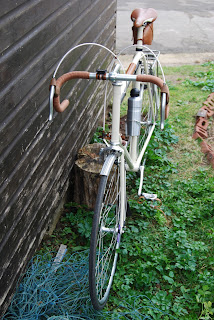

I stripped down my old custom built Bob Jackson frame, had it powder coated, bought some second hand track wheels from my lbs, made some leather bits and pieces and trawled the internet for various cheap but gorgeous bits, rode it a couple of weeks and realised I could drop a gear to make it that bit easier on the flats and downhill. I'll keep this updated as I approach the Suffolk Sunrise century on May13th.
Next year, the Goodwood 24hrs beckons...........
I'm being narratively selective here of course: my late teens and early twenties were spent walking, cycling, running and climbing and I had a healthy, fit lifestyle too. I discovered rock climbing and realised that basic cardiovascular fitness and strength could enhance my performance, achievements and subsequent pleasure. I also discovered the value of good nutrition and became adept at choosing food and drink that could be carried easily in a small rucksack!

In a moment of hubris I attempted a climb a bit beyond me. I fell, my protection unzipped and I landed feet first on a boulder and broke all three bones in my ankle. So aged 23 I could not run, found walking painful, and could not climb to any decent standard. So I started scuba diving, not exactly high intensity work. Looking back, I don't think I did any significant cardiovascular exercise for about twenty years when I rediscovered cycling, but only as a commuter in London. I flirted with the YMCA gym but it was a one sided affair and we split up after a year.
Last year I took the decision to train for and complete a cycling century. I used a fabulous book: The Complete Book of Long Distance Cycling, to inform my carefully graded rides and to prepare food and drink. I had a eureka moment when I found some research by a Spanish doctor who found that beer was the perfect carbohydrate replenishing drink after a hard ride.

The next comment is not bragging but a testament to the training and nutrition I got from the book. I found it easy. I averaged 14mph, took it easy and enjoyed every minute. In a bizarre way I felt a bit cheated. No anguish I pushed myself through, no burning pains I forced myself to endure, and no bonk ( the enervating result of poor nutrition ).
Where to from here then? I felt that the time needed for a double century would be too intrusive into family life and professional obligations. I'd just become aware of fixies and built a very crude one for winter riding. The unexpected happened and I became fixated (!) on riding longer and longer distances. The outcome was obvious: a fixed gear century.
The training for last year largely consisted of working within carefully constrained pulse rates so as to increase endurance and efficiency without depleting energy stores. Cardio vascular work was an almost completely separate programme and developed heart and breathing efficiency together with muscle tone and strength. With a geared bike it's relatively easy to separate out these factors and concentrate on one aspect: if your heart rate goes beyond your zone just drop a gear and go slower or free wheel a bit! If you need to push your rate into the cramp zone then raise a gear and push hard. Not so easy on a single gear. I'm getting to know the topography of North Norfolk very well. All my training rides need to be planned around hills and flats so I can at least have a basic model of what I'll be improving. What I am finding is that I'm very quickly learning to relax in punishing situations. To get a reasonable downhill speed you need to get a cadence of 120 or 130. Something like this:
It takes a lot to convince your body that you can relax!
One of the upshots of last year's efforts was the realisation that I was basically, and despite various leg injuries, quite fit with the maximum HR of a 45 year old. I'm now proselytising about teenage fitness to my pupils and children!
I'm also revisiting some skills I learned when beginning to dive. It's amazing how far you can swim on one breath if you can completely relax.
So at the moment it's a case of trying to keep smooth, controlled and within heart rate zones, increase times and distances and maintain comfort.
What to eat and drink? Shops and magazines would have you spend fortunes on bars and gel and drinks and powders. After a bit of web research I found some recipes for energy drinks and tried a couple. I now swear by a combination of Lady Grey tea, lemon juice, brown sugar and cardamom pods with a pinch of salt. I drink this fairly concentrate for the first two or three hours, (every 15 mins!!) and then dilute it further with cold water for the rest of the ride.
Food was a bit more of a problem: I got heartily sick of sweet stuff and long distance cyclist Dave suggested marmite sandwiches. Have yet to try these but I think they'll supplement the homemade flapjacks really well. The Really Important Thing is to keep eating and drinking.
And finally, despite Lance Armstrong, it is a bit about the bike!


I stripped down my old custom built Bob Jackson frame, had it powder coated, bought some second hand track wheels from my lbs, made some leather bits and pieces and trawled the internet for various cheap but gorgeous bits, rode it a couple of weeks and realised I could drop a gear to make it that bit easier on the flats and downhill. I'll keep this updated as I approach the Suffolk Sunrise century on May13th.
Next year, the Goodwood 24hrs beckons...........
Monday, 9 January 2012
Arrowheads, Perfection and Compassion
I lately came across an article in New Scientist which linked early technological advances with "maverick" ways of thinking. Autisim was mentioned along with bipolar and schizophrenia: What a surprise!!


http://www.orange.networkofcare.org/mh/news/detail.cfm?articleID=36999
A very brief précis is that emerging technologies thrive on difference, and that there is a little prehistoric evidence for compassion and caring for those individuals who are different.
A very brief précis is that emerging technologies thrive on difference, and that there is a little prehistoric evidence for compassion and caring for those individuals who are different.
Two weeks later I was watching Alice Roberts' excellent series "The Incredible Human Journey", when she showed us an arrow head, or Clovis point from the Neolithic period, about 11,000 years ago. It was stunningly beautiful with an elegant symmetry and minutely scalloped edges. From a purely functional point of view it need not have been so perfect, and from a time / outcome ratio a "rougher" job would have been much more efficient.
 |
| A collection of authenticated Clovis Points circa 11,000 BC |
As readers of these meanderings will know, my wife, currently waiting for an Aspergers diagnosis, is a keen seamstress and knitter.
At this very moment she is weaving in all the ends of yarns into the rows of a beautiful woollen sweater she's knit for me. It's taken nearly a year mainly because of the demands of our delightful children and the housekeeping she undertakes so rigourously. Also she has, on numerous occasions, undone rows and rows because of slight errors in either tension or stitches. The yarn weaving is to prevent the different colours from separating. This almost certainly would not happen but the weaving means it could not. Perfect, see, just like the seams on her Tudor costume, the cleanliness of the kitchen floor and the organisation of the log piles for the stove.
In another part of my life I was a carpenter and turner. I loved turning sycamore so thin you could see light through it and these were very popular pieces. I often wondered what the customers did with these as the function of the bowl was actually impaired by the thinness. Craftsmanship seem to still matter, but some of the neolithic pieces are breathtaking in their beauty and finish.

A few of the tools seem to be ceremonial and are precisely perfect as an offering of craft, but some are totally functional and have been obviously used.

If it can be done, it can be done perfectly!
I'm not sure if Penny Spikins' theory could be considered as anything more concrete than wishful thinking. I do know, however, that people with AS have unique talents and can bring joy and delight to any group prepared to look beyond the "normal". Compassion is NOT pity! To me, it is an acceptance of difference and an enlarging of our concepts of what our group is to encompass those differences
My job (and my passion) at my school seems to be that of celebration. Everyone is included, listened to and enjoyed! I try to show my pupils that they are all valued. This has enormous benefits for the productivity of the group as very little time is spent managing behaviour and we can all just get on and learn in whatever style and mode suits us.
And please, can we miss the D out of ASD (unless it stands for delight!)
Thursday, 20 October 2011
Uncomfortable Aesthetics
Three things you probably don't know and wouldn't guess about me:
- I love military aircraft, more particularly fighters.
 |
| General Dynamics F-16 |
Duxford air show is a particular delight and I generally go to a couple each year. I always take one or both of our children and occasionally one or two of their friends. This gives it a sort of educational aspect and earns huge parenting brownie points. And this isn't even mentioning the envious and knowing smiles I get from the mums of other families, who I guess are sometimes there under sufferance!
The truth is that I'm following my dad's example who took me and my brother to motor cycle races and air shows. To this day I don't know whether my passion for bikes and planes is just because I loved our days out together with our fantastic dad .
- I love racing motor cycles, especially Italian and Japanese multi cylinder machines.
 |
| 250cc 6 cylinder 1967 Honda |
Similar reasons for liking bikes and planes I suppose: both very pared down engineering where speed, weight, ergonomics and aerodynamics determine the form.
In the twenties, a French Swiss architect, Le Corbusier, wrote an influential treatise about architecture illustrated with pictures of cars, ships, civil engineering projects and farm and industrial developments. His premiss was that houses should be "machines for living" and their form should follow their function and not be a series of boxes with bolted on historical references. This approach to design resulted in some fabulous (to my eyes) minimalist architecture that still looks modern after over 80 years. The International Style was a movement that produced the Bauhaus with all its astonishing output, and was fuelled by a philosophy and aesthetic similar to my beloved bikes and planes.
In the twenties, a French Swiss architect, Le Corbusier, wrote an influential treatise about architecture illustrated with pictures of cars, ships, civil engineering projects and farm and industrial developments. His premiss was that houses should be "machines for living" and their form should follow their function and not be a series of boxes with bolted on historical references. This approach to design resulted in some fabulous (to my eyes) minimalist architecture that still looks modern after over 80 years. The International Style was a movement that produced the Bauhaus with all its astonishing output, and was fuelled by a philosophy and aesthetic similar to my beloved bikes and planes.
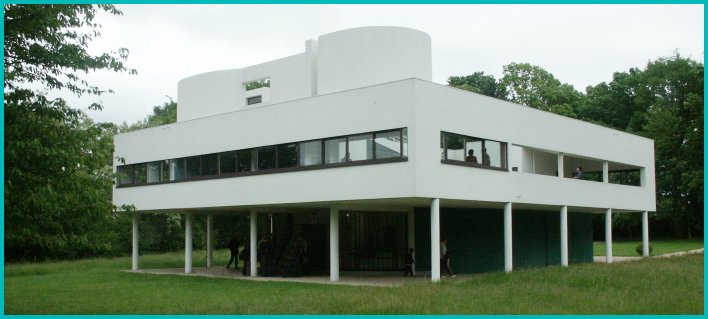 |
| La Ville Savoye 1929 |
- I failed an Architecture degree course at Aston University (First year).
Perhaps I should have studied engineering!
Anyway, I was particularly looking forward to Sunday's display as the F-16 was flying. This is arguably one of the most ubiquitous planes ever made, flying in over 25 Air Forces from Norway to Thailand. I had followed its development since the early seventies and loved its sinuous, taut rather than voluptuous, shape. So there I stood ( chairs at air shows are for oldies! Besides, you can't use a camera properly from a chair) and at about 1 o'clock a blue grey shape came from the east and quickly defined itself as the Belgian Air Force F-16.
 |
| I took rather a lot of pictures of the F-16! |
I'm used to Spitfires, Hunters, Sabres, and all the usual Duxford fair of easy, low stressed, manoeuvres with lovingly rebuilt and maintained machines and I just wasn't prepared for the sheer power and chutzpah of this plane. It didn't so much float on the air as rip it apart and I loved the power of the engine which growled and thundered like a demented animal. I was entranced. I wasn't just entranced: I was genuinely awe struck and in tears. What astonishing power and beauty the human race is capable of! Not only to design and build such a thing of beauty but to train to subject yourself to over 6g to fly it.
Then the unease set in: The WW11 planes are a historical statement and a primary source ( eduspeak),
but the modern stuff, especially hardware in service and fighting, seems a bit near to glorification of conflict. I have problems with guns too. I'm not a bad shot for a pacifist* and the feel of a wooden stock against your cheek and shoulder, the blue of the steel and the craftsmanship is a delight. We don't let our son buy guns with his pocket money but he makes them from lego or carves them from sticks. AAARRGGHHH! Well at least he's engaged in a real craft and not playing "Call of Duty"like many of his eight year old class mates claim to be! And I actively encourage his archery skills as well as improving my own.
So where does that leave me? I'll still take my children to the air shows because thats what good dads do. I'll still enjoy the sound and sight of military aircraft. I'll still shoot rifles when I can and I'll make and shoot longbows at Kentwell. And I'll accept the unease and share it, and I'll carry on teaching pacifism and conflict resolution and try to keep alive that vaguely hippie ideal of peace and love.
* Target shooting of course!
Then the unease set in: The WW11 planes are a historical statement and a primary source ( eduspeak),
but the modern stuff, especially hardware in service and fighting, seems a bit near to glorification of conflict. I have problems with guns too. I'm not a bad shot for a pacifist* and the feel of a wooden stock against your cheek and shoulder, the blue of the steel and the craftsmanship is a delight. We don't let our son buy guns with his pocket money but he makes them from lego or carves them from sticks. AAARRGGHHH! Well at least he's engaged in a real craft and not playing "Call of Duty"like many of his eight year old class mates claim to be! And I actively encourage his archery skills as well as improving my own.
So where does that leave me? I'll still take my children to the air shows because thats what good dads do. I'll still enjoy the sound and sight of military aircraft. I'll still shoot rifles when I can and I'll make and shoot longbows at Kentwell. And I'll accept the unease and share it, and I'll carry on teaching pacifism and conflict resolution and try to keep alive that vaguely hippie ideal of peace and love.
* Target shooting of course!
Sunday, 9 October 2011
'Tis a Gift to be Simple.
I've just started serious cycling again. I suppose most of you reading this know I've done an event recently involving 100 miles cycle around Norfolk for charity. If not, then you know now! All sorts of bicycles passed me: mountain bikes with knobbly tyres whirred, state-of-the-art carbon fibre frames rumbled, aluminium racers whistled by, oh, and occasionally I passed other bikes. I had a great time, I completed the course with no discomfort, no pains, no blisters but a huge sense of achievement.
This was the first "big" cycling I'd done and I was really fired up all through my training month. I'd read all I could get hold of through the 'net and books, but the best advice was from an American book:
http://www.amazon.co.uk/Complete-Book-Long-Distance-Cycling/dp/1579541992/ref=sr_1_2?ie=UTF8&qid=1316369417&sr=8-2
This more or less said the bike you're comfortable with and have ridden should be fine. It was. It advised against specialised, usually very expensive, in the way of wheels, tyres, gearing, pedals etc.
I liked this philosophy and so did my my wife and my bank manager. My own bike was a ten year old steel frame tourer which fits me perfectly and has seen me commuting in London, Birmingham and finally Norfolk. Its simplicity has always appealed to me.
But I've also recently come across groups of cyclists all over the world who were trying to simplify their cycling even more. Fixies are stripped down bikes with an aesthetic all of their own. Most people adapt their own or buy a cheap secondhand frame, but you can buy quite expensive ones ready made. These cycles effectively have one gear, one brake, a frame and two wheels. Do you remember your first ever bike? It was probably like this but with a free wheel so you could rest on the pedals.


This was the first "big" cycling I'd done and I was really fired up all through my training month. I'd read all I could get hold of through the 'net and books, but the best advice was from an American book:
http://www.amazon.co.uk/Complete-Book-Long-Distance-Cycling/dp/1579541992/ref=sr_1_2?ie=UTF8&qid=1316369417&sr=8-2
This more or less said the bike you're comfortable with and have ridden should be fine. It was. It advised against specialised, usually very expensive, in the way of wheels, tyres, gearing, pedals etc.
I liked this philosophy and so did my my wife and my bank manager. My own bike was a ten year old steel frame tourer which fits me perfectly and has seen me commuting in London, Birmingham and finally Norfolk. Its simplicity has always appealed to me.
 |
| Me and my Bob Jackson Tourer (camouflage to deter thieves!) |
But I've also recently come across groups of cyclists all over the world who were trying to simplify their cycling even more. Fixies are stripped down bikes with an aesthetic all of their own. Most people adapt their own or buy a cheap secondhand frame, but you can buy quite expensive ones ready made. These cycles effectively have one gear, one brake, a frame and two wheels. Do you remember your first ever bike? It was probably like this but with a free wheel so you could rest on the pedals.

I loved the idea of this but wasn't sure how I'd get on with riding one as it's pretty hilly around Norfolk despite what Noel Coward wrote.
Don't you just love ebay? I found a cheap bike with a huge frame ( my inside leg is 35"!) which was fairly close and won the auction. It was sold by a lovely retired USAF officer and it was shipped over from the States in the eighties. It was extremely crudely made but very comfortable and almost identical in size and geometry to my beloved Bob Jackson.
I stripped off the gears, got my LBS (Local Bike Shop, a great American abbreviation) to fit a gear and locking ring to the rear wheel, heeded advice to keep both brakes and tried it out. A time of bleeding shins, strained thighs and lots of giggling ensued as I got to grips with pedals my legs had to revolve with. After about a week or so of commuting I got the hang of it. I got the hang of it so much that I could get up the hills I used to drop through all the gears for and manage to keep my legs revolving down really wooshy hills. And the giggling continued and still continues! I'm even considering cycling the 25 miles to Norwich on it next week.
It's now hanging in the garage having the paint job it deserves instead of the rather sober grey scheme it came with. As I paint it, I feel the sort of pleasure I felt with my first bike. The pleasure of a bit of machinery I can maintain myself, that was inexpensive, that was fun to ride and that was essentially an extension of me.
 |
| Finished! |
Yes I did ride it from Norwich yesterday and had a wonderful time. I cramped up in the evening and feel quite achey today but I love the freedom and simplicity I have when riding it:
YOU JUST PEDAL!

We live in an increasingly complicated world, how good it is to recapture some of the simplicity of a happy childhood! And also some of the silliness.

Sunday, 12 June 2011
Religion and Cocktails
I suppose it had to happen.....couldn't keep quiet about religion for long.
I'm having to do a lot of thinking about religion, fundamentalism, evangelism, conversion etc at the moment. I'm a member of the local Sacre group, a really lovely lot of people of all sorts of religious persuasions who are totally committed to giving the children of Norfolk as good an education about religions as we can. We meet about once a term and look at ways we can get schools to become more enthusiastic about the teaching of religious education. I've belonged to a multi-faith group before in 1995, in Newham, possibly the most culturally and religiously diverse of London boroughs.
So there we were, all of us, including Sikhs, a couple of Muslims, a Hindu couple, Christians of all persuasions, a Buddhist, a delightful Baha’i woman, even a pagan, meeting at the local methodist community centre, talking about how we could raise awareness of faith issues in schools and the borough in general. Quite suddenly, apropos of nothing at all, an Anglican Minister said, “Of course, you realize you’ve got it all wrong, only Christianity has got it right”. I thought it was a joke, surely in this company it must be: it wasn’t. He genuinely meant it. I couldn’t believe anyone could be so crass. After a rather embarrassed silence the meeting wound up. I never went again.
On Tuesday I saw a news item about the Government trying to legislate against fundamentalist led terrorism and trying to pump money into Islamic hot spots. Outrage welled up within me, a feeling I’d not associated with the 10 o’clock news since the eighties! (Ever so sorry to those under 30, you won't remember Thatcher). I was furious that so called intelligent and informed politicians couldn’t see that it wasn’t Islamic fundamentalism we should be afraid of, it was any religious fundamentalist. My mind went back to those horrific days when an ex alcoholic bigot was the most powerful single person on the planet. I remembered with deep embarrassment that it became acceptable to be a “creationist thinker” (surely a contradiction in terms) and that it became mandatory in some states to teach Intelligent Design.

My eleven year old daughter at the moment is having to sing some songs in assembly which, while not out of place in a Baptist church, are quite questionable in a state primary school. The same school has started a Fish Club. This looks at Bible stories, is run by a "born again" Christian and is advertised widely in the school. I have this virtual sister school in Forest Gate where the local fundamentalist Imam sets up a club…… yes, precisely.

Incidentally, I questioned my daughter about what she thought religion might be. Almost verbatim, these are her words:
“ I think human beings like to make sense of things. I think religions are the stories they tell when it gets too complicated for thinking. Because there are different groups of people all over the world, there are bound to be lots of religions.”
Thank you Sue, for encouraging the children in your care to think!
Cocktails: So many from Harvey Wallbangers to Caipirinhas. We all have our favourite. All seem to make the world a happier place.
Religions: So many from Hinduism to Atheism. We all have our belief. All should make the world a better place.
Cheers!
Cocktails: So many from Harvey Wallbangers to Caipirinhas. We all have our favourite. All seem to make the world a happier place.
Religions: So many from Hinduism to Atheism. We all have our belief. All should make the world a better place.
Cheers!
Saturday, 7 May 2011
Masks, Identities and Authenticity.
We've just got back from a couple of fantastic long weekends at Kentwell. I am supposing that if you are reading this you'll know what this is, and why it is such an important a part in my life. If not then follow the link:
http://www.kentwell.co.uk/Re-Creations/Tudor
I met most of my best friends here including my bestest friend. I have often wondered why this is so. When I first went to Kentwell I was a teacher in charge of a small group of 10 year olds and because we were supposed to dress in a "Tudor" style and I was a bit of an exhibitionist (!!!!) I borrowed a pair of opaque tights, made myself a red felt codpiece, adapted an old fawn shirt and topped the lot off with a straw hat.
How was I to know that most other teachers just tucked their trousers into longish socks or wore a long skirt?
We passed through a dark, narrow time tunnel and emerged into what can only be described as a sensory heaven. People in russet and other muted colours drifted over lawns in front of a manor house. Everywhere was the smell of woodsmoke. A couple of pipers and a drummer were playing unrecognisable but haunting music and all was peaceful. In those days you could see nothing that wasn't authentic (such an important concept for us re-enactors!). As we progressed around the manor, through the farm, looking at and smelling smiths, charcoal makers, potters and builders, women kept on making comments like, "Fine arse!" "Well met, Fellow. Art thou in search of a wife?" etc (modesty forbids me to go on!)
Anyway after a fantastic time crowned by a wild dance to some of the most exciting music I'd heard (apart from Samba, naturally), a re-enactor came up to me and, committing the dreadful sin of coming out of role, told me how to apply to be part of it and suggest I might fit in with the 200 or so people on the manor.
So I made me a costume, went to see Patrick Phillips whose train set it was and who made sure we wouldn't break it or mess it up and the rest, as they say, is history.

So what makes us relinquish the modern world for a week or two or three in some cases, live in a tent or at best a caravan with very limited conveniences, research a role, learn to speak in a Tudorese cross between Shakespeare, the Bible, and Carry on Henry and learn skills that in most cases have been forgotten? Fun of course! And the chance to reinvent ourselves so convincingly that our best Kentwell friends may not know what we do in our other lives. (Notice I did not use the phrase, "Real World").
Patrick always says in his (long) speech to newbies that many see their Kentwell personae as their primary identities. It's a Kentwell aphorism that a gentry dustman will talk to a beggar doctor and neither knows who they "really" are.
My contention is that our education, our jobs and to a certain extent our dress are masks we have been wearing for years and that Kentwell give all of us a chance to rediscover our true selves. Patrick's genius is his ability to sum up people in a few minutes, offer them a role and allow and encourage them to develop that role whether it is a real historical gentle man, or a wandering player. We are left very much to ourselves with a bit of advice and a whole lot of peer support and somehow it all works beautifully and convincingly.
Authenticity can mean a hand sewn woollen and linen costume, a tool collection that will appear to be correct, songs which sound right or were written before the year we are re-creating. But it can also mean becoming the person you really enjoy being and who can relate to others. Kentwell not only allows that, it actively encourages it.
And there's not a sentence of writing we need to do!
(But we're not paid either!)
http://www.kentwell.co.uk/Re-Creations/Tudor
I met most of my best friends here including my bestest friend. I have often wondered why this is so. When I first went to Kentwell I was a teacher in charge of a small group of 10 year olds and because we were supposed to dress in a "Tudor" style and I was a bit of an exhibitionist (!!!!) I borrowed a pair of opaque tights, made myself a red felt codpiece, adapted an old fawn shirt and topped the lot off with a straw hat.
How was I to know that most other teachers just tucked their trousers into longish socks or wore a long skirt?
We passed through a dark, narrow time tunnel and emerged into what can only be described as a sensory heaven. People in russet and other muted colours drifted over lawns in front of a manor house. Everywhere was the smell of woodsmoke. A couple of pipers and a drummer were playing unrecognisable but haunting music and all was peaceful. In those days you could see nothing that wasn't authentic (such an important concept for us re-enactors!). As we progressed around the manor, through the farm, looking at and smelling smiths, charcoal makers, potters and builders, women kept on making comments like, "Fine arse!" "Well met, Fellow. Art thou in search of a wife?" etc (modesty forbids me to go on!)
Anyway after a fantastic time crowned by a wild dance to some of the most exciting music I'd heard (apart from Samba, naturally), a re-enactor came up to me and, committing the dreadful sin of coming out of role, told me how to apply to be part of it and suggest I might fit in with the 200 or so people on the manor.
So I made me a costume, went to see Patrick Phillips whose train set it was and who made sure we wouldn't break it or mess it up and the rest, as they say, is history.

So what makes us relinquish the modern world for a week or two or three in some cases, live in a tent or at best a caravan with very limited conveniences, research a role, learn to speak in a Tudorese cross between Shakespeare, the Bible, and Carry on Henry and learn skills that in most cases have been forgotten? Fun of course! And the chance to reinvent ourselves so convincingly that our best Kentwell friends may not know what we do in our other lives. (Notice I did not use the phrase, "Real World").
Patrick always says in his (long) speech to newbies that many see their Kentwell personae as their primary identities. It's a Kentwell aphorism that a gentry dustman will talk to a beggar doctor and neither knows who they "really" are.
My contention is that our education, our jobs and to a certain extent our dress are masks we have been wearing for years and that Kentwell give all of us a chance to rediscover our true selves. Patrick's genius is his ability to sum up people in a few minutes, offer them a role and allow and encourage them to develop that role whether it is a real historical gentle man, or a wandering player. We are left very much to ourselves with a bit of advice and a whole lot of peer support and somehow it all works beautifully and convincingly.
Authenticity can mean a hand sewn woollen and linen costume, a tool collection that will appear to be correct, songs which sound right or were written before the year we are re-creating. But it can also mean becoming the person you really enjoy being and who can relate to others. Kentwell not only allows that, it actively encourages it.
And there's not a sentence of writing we need to do!
(But we're not paid either!)
Subscribe to:
Posts (Atom)